
12/03/2026
Bolivia Ecológica is a space for those who wish to know and to care for our country. Its strength does not lie in merely “speaking of the environment” in general terms, but in something more difficult: transforming biodiversity into public knowledge. It accomplishes this through a precise editorial form: each issue takes a theme—an ecosystem, a group of species, a relation between culture and nature, an ethical question—and develops it with clarity, context, and avenues for further inquiry. This combination explains why Bolivia Ecológica functions both as a review and as a library: each edition constitutes a complete unit of reading, and the accumulated archive allows anyone to find a point of entry according to his or her interest. In its digital collection, the review invites readers to explore more than one hundred editions.
The question that runs through this editorial undertaking is simple, yet demanding: how may a review (and its digital library) bring science and biodiversity closer to a wide public, while maintaining both clarity and rigour? The answer lies neither in “lowering the level” nor in transforming science into a slogan. It consists in designing understanding: editing knowledge in such a way that it remains faithful to its foundations, while becoming legible and appropriable for non-specialised readers. Bolivia Ecológica attains this equilibrium through five editorial decisions that function as a system.
1) A verifiable rigour: the content leaves a trace of its sources
In several issues, Bolivia Ecológica clearly states that its aim is scientific popularisation and the cultivation of environmental awareness. This commitment rests not merely upon tone, but upon verifiable signals: each edition includes a bibliography and sources that show whence the information proceeds and allow the reader to follow the path of knowledge, rather than remaining with isolated assertions.
For example, in the issue devoted to woodpeckers, the objective of disseminating knowledge and promoting environmental awareness is explicitly affirmed, and is supported by a specialised bibliography mentioned at the end of the number. It is this that lends solidity to the editorial project: rigour does not depend upon complicated writing, but upon making visible the foundation of the content and opening a path for further study.
2) A functional clarity: the reading is conceived for the learner
Clarity in popularisation does not signify “simplifying to the extreme”. It consists in preventing the reader from losing his way. This is achieved through an architecture of reading: sections, sub-themes, definitions, explanations, and, in certain cases, glossaries and bibliographies.
A visible example of this functional clarity is the issue devoted to the Andean condor, which includes a glossary as well as a bibliography, thereby reducing the barriers for non-specialist readers without renouncing substance. When a review incorporates such instruments, it does not merely disseminate: it teaches.
3) Editorial unity as method: each issue is a map of the subject
One of the greatest risks of environmental popularisation is fragmentation: immense subjects presented in small pieces which inform, yet do not build understanding. Bolivia Ecológica follows the opposite path: each edition functions as a map. One enters by a gate (a theme) and emerges with a complete and ordered journey.
This design allows for depth without overwhelming the reader, because the subject is structured; and it simultaneously favours appropriation, since the reader gains the impression of acquiring an articulated vision rather than a mere accumulation of data.
4) From biodiversity to daily life: knowledge becomes pertinent
A review becomes truly public when what it explains ceases to be merely “information” and becomes an understanding that alters the manner in which the territory is perceived. This transition occurs when biodiversity is presented as something that influences concrete decisions and relationships: the forest as a system, species as indicators, practices as forms of conservation, ethical tensions as an integral part of coexistence with the living world.
For this reason it is so powerful that the catalogue includes not only fauna and flora, but also intersections between nature, culture, ethics, and human practices, as in the issue on ethnoecology or that devoted to ethics and the mistreatment of wild and domestic animals.
5) The library as democratisation: the archive multiplies access without diluting the content
In a country where access to specialised materials often depends upon institutions, the existence of a consultable archive makes possible something fundamental: that interest alone suffices to begin. The breadth of the catalogue forms part of its strength, for there is always an issue capable of awakening attention through a different gateway and sustaining it through a complete intellectual journey.
Bolivia Ecológica is better understood if one regards it as a review that fulfils three functions at once. On the one hand, it operates through thematic curation: it does not publish “a little of everything”, but constructs editions with a precise focus, wherein each issue develops a theme through a clear intellectual course. On the other hand, it acts as a form of scientific translation, for it takes specialised knowledge and renders it into public reading, while maintaining avenues for further study through a bibliography and sources that sustain the content. Lastly, it functions as a reusable educational instrument: by virtue of its editorial structure, many issues may become material for the classroom, for workshops, libraries, reading circles, or self-instruction.
This combination produces a rather uncommon effect: the review does not exhaust itself at the moment of reading; it remains as a resource.
The engine of curiosity: what changes from one issue to another
The most attractive aspect of Bolivia Ecológica lies in the fact that each edition opens a different gateway. It is not a single environmental conversation repeated again and again; it is a catalogue that traverses ecosystems, species, territories, and questions.
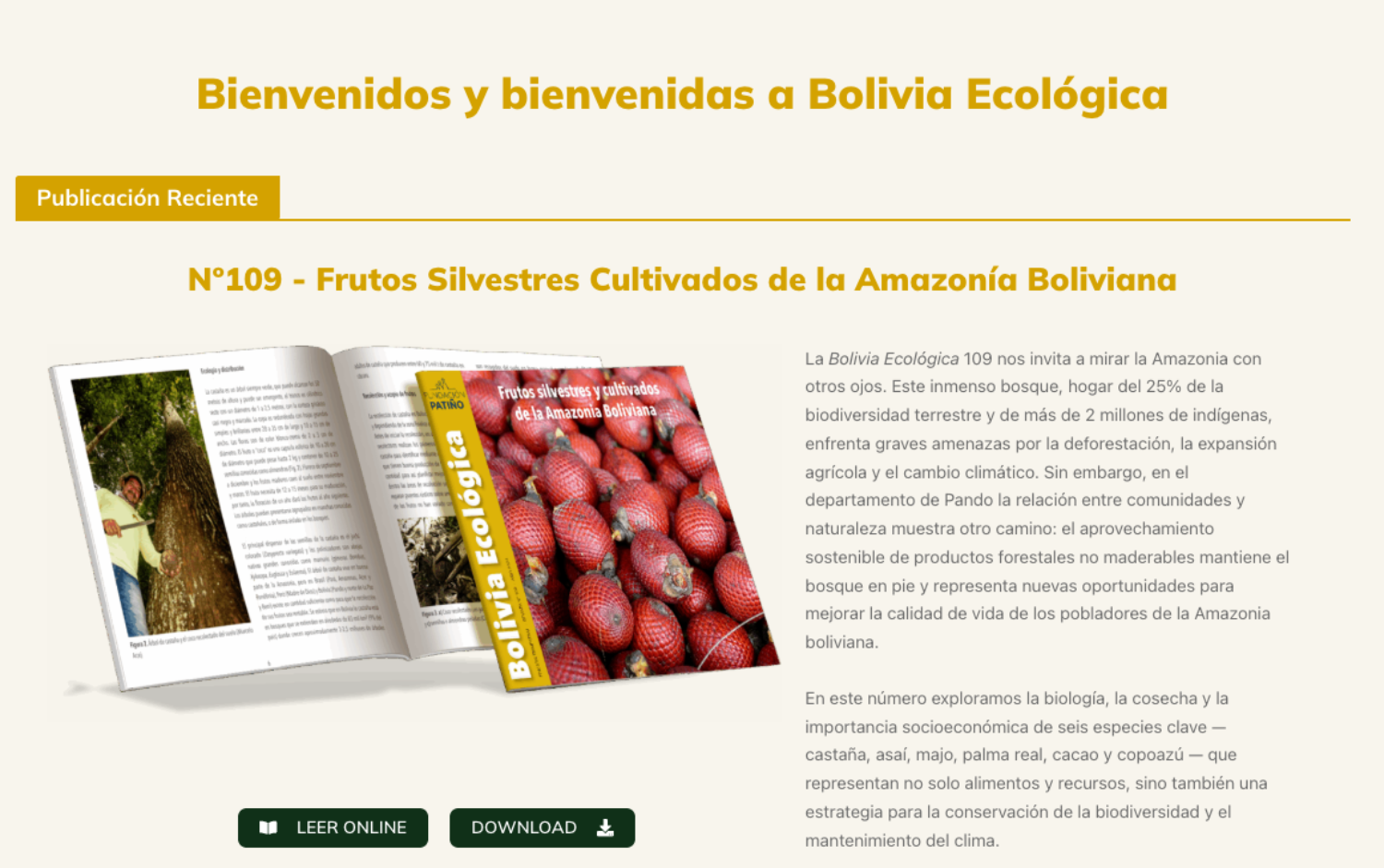
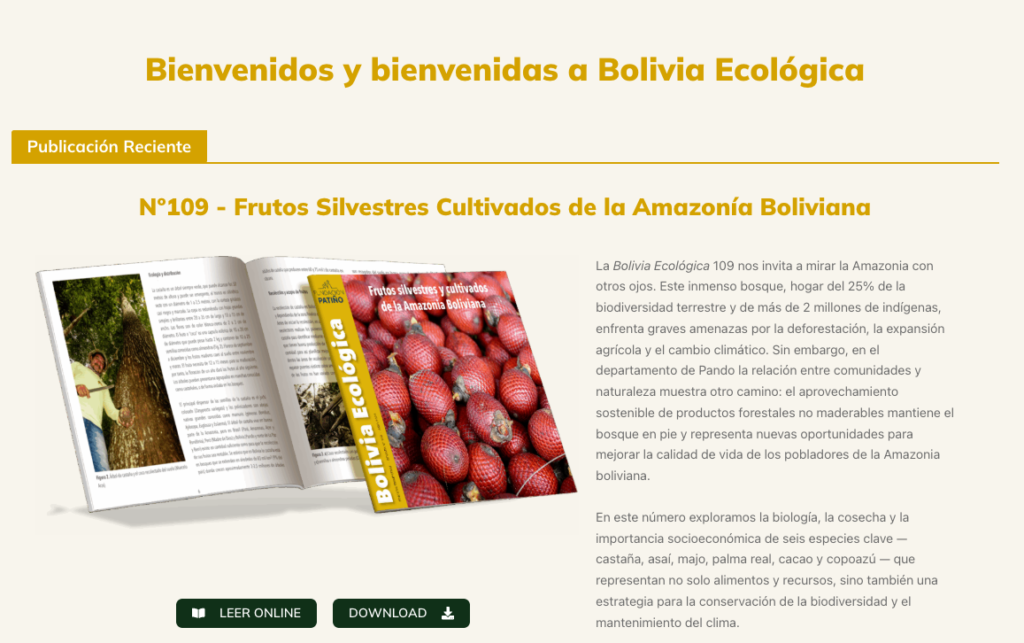
By way of example of this thematic diversity (all the editions being consultable in the archives): the Bolivian Amazon and cultivated wild fruits; the diversity of amphibians in Bolivia; woodpeckers; trees and their ecological function; succulent plants; birds of prey and the Andean condor; ethnoecology; ethics and the mistreatment of animals.
Such is the editorial promise: one may enter by that which most attracts him—fauna, flora, forests, the Amazon, ethics—and each issue offers a complete intellectual journey.
How to choose your first issue
If this is the first time you encounter Bolivia Ecológica, the best course is to enter by affinity.
If you are moved by learning through concrete species (and appreciate a “case-based” approach), choose an issue centred upon a specific group—amphibians, birds, birds of prey—for these are often direct points of entry, combining scientific explanation, context, and clear detail.
If your interest lies in understanding ecosystems and reflecting upon territory, seek out issues that explore ecological functions and broader dynamics—forests, trees, the Amazon—for these organise ideas and connect nature with human decisions.
And if you are drawn to the intersection between nature and society, choose editions that open cultural, ethical, or questions of coexistence: these are well suited for reflecting upon how the living world is experienced, decided, and valued.
What makes an issue “good” with which to begin
A good first issue need not be “the most important”: it must simply offer a complete experience of reading.
In Bolivia Ecológica, this usually occurs when the theme is clearly delimited and the edition sustains a concrete promise—a group of species, an ecosystem, a practice, or an environmental dilemma—for such clarity allows the reader to advance with orientation, without becoming lost among dispersed ideas.
It is likewise helpful when the content is organised as a readable course: an issue “good for beginning” situates the theme, develops it through sections, and conducts the reader from the general to the particular, adding instruments that reduce the barriers for non-specialist readers and strengthen the foundation of the content.
Finally, an ideal issue with which to begin is one that does not exhaust itself upon the closing of the final page: it leaves avenues for deeper study and references through which to continue exploration, so that the reading becomes a point of departure rather than a conclusion.
Why this review matters within the framework of the Patiño Foundation
Bolivia Ecológica presents itself as a space that unites science and citizenship, directed toward education and environmental popularisation. In a megadiverse country, protection demands more than messages: it requires knowledge that may be accumulated, consulted, and shared.
A review with open archives and thematic editions constructs precisely this: a foundation of understanding capable of growing with each reading.
If you have reached this point, the next step is simple: enter, choose a theme, and allow each edition to guide you.
Home
Your curiosity has already chosen the theme; now choose the issue!
09/04/2025
22/03/2025
06/02/2025

12/01/2025