23/03/2026
What remains of our objects when they cease to serve?
What do they still reveal of us, of our trajectories, of our ruptures, of our memories?
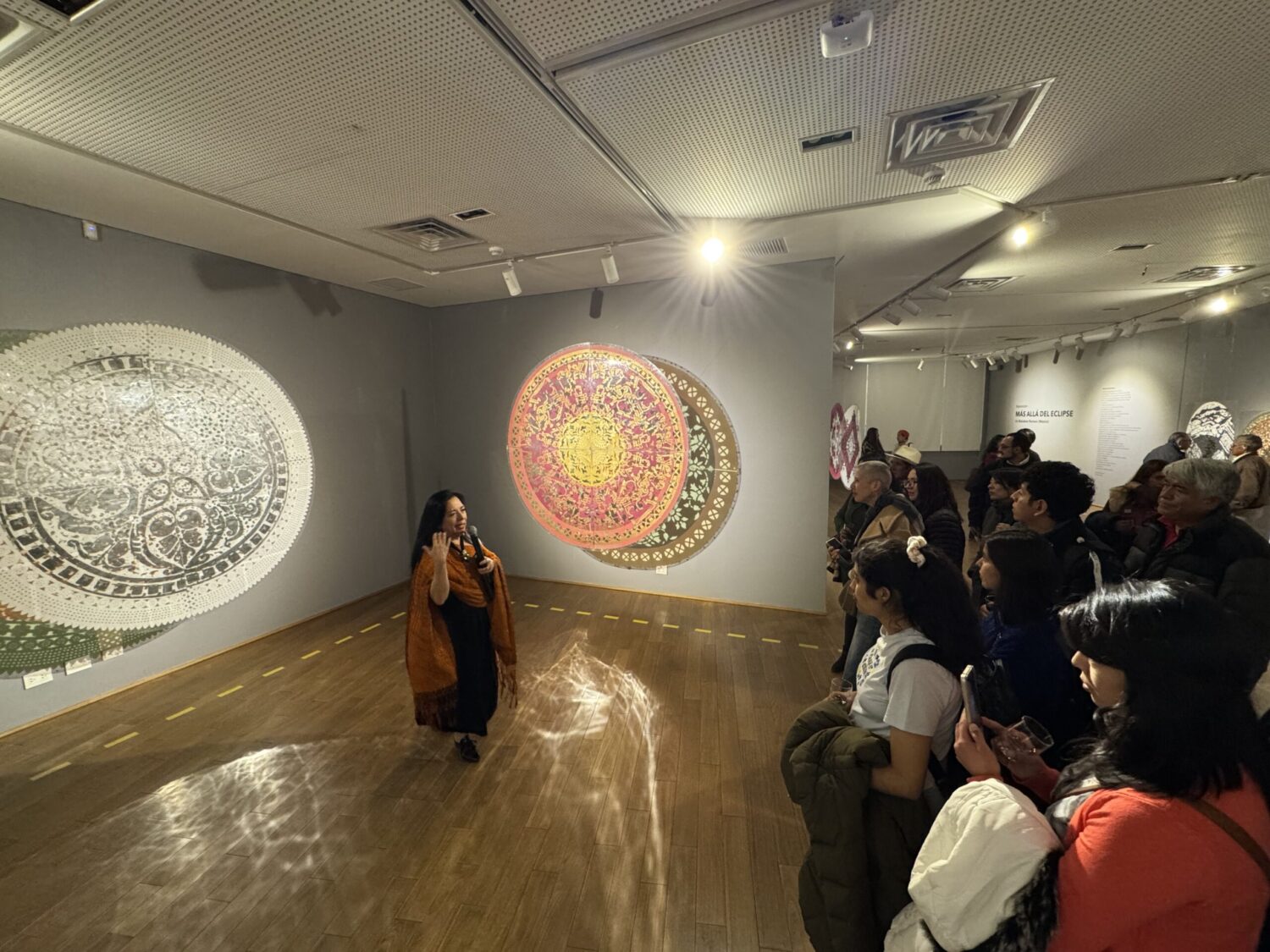
With “Beyond the Eclipse,” the Mexican artist Betsabeé Romero does not propose a mere exhibition. She proposes a passage. A passage through the everyday, through its remnants, its traces, to reveal what they still contain.
Here, nothing is spectacular. Everything is essential.
Trained in the history of art and endowed with an international career, Betsabeé Romero has fashioned a body of work that refuses abstraction severed from life. She works with what the world produces, uses, and discards: tyres, car bodies, textiles, paper.
Yet she does not détourne them. She transforms them.
A tyre engraved with floral motifs does not become a work through provocation. It becomes memory. Trace. Presence. That which was destined for oblivion regains a certain density.
This gesture is not neutral. It is a stance.
Romero does not denounce in a frontal manner. She acts from another place. She collaborates with communities, reactivates artisanal know-how, sets back into circulation forms that the market had relegated. She does not deconstruct. She repairs.
At the heart of the exhibition, one object recurs: the tyre.
A banal object, almost invisible, and yet laden with history: movement, use, transit. In the artist’s hands, it becomes something else. A ritual support. An object of memory.
As for the automobiles, they cease to represent the modern promise of mobility. They are transformed into marked surfaces, into open scars, at times into altars.
Each work rests upon a tension:
between object and symbol,
between wound and celebration.
What Romero proposes is not an aesthetic transformation. It is a re-reading of the world from its traces.
The exhibition addresses a central theme: migration.
Yet it does not present it as an abstract phenomenon. It renders it tangible. Visible. Material.
Through an iconography that interweaves indigenous, popular, and urban elements, Betsabeé Romero makes visible the invisible transformations: the inward displacement, the recomposition of identity, the marks left by the constant passage between territories.
Here, identity is never fixed.
It is constructed, displaced, transformed.
Mestizaje is not a loss. It is a strength. A capacity to create, to connect, to transmit.
One of the great strengths of “Beyond the Eclipse” lies in its capacity to make different temporalities coexist.
The motifs, the gestures, the materials bear an ancestral memory. A cosmovision in which objects are not neutral, in which every form is charged with meaning. This memory enters into dialogue with the present.
Not from nostalgia.
From action.
As the curator Oscar Roldán observes, cultural freedom does not consist in breaking with one’s roots, but in reactivating them as a source of creation.
In this perspective, Romero’s work advances a clear and exacting idea:
the future is not built through forgetting, but through reinterpretation.
“Beyond the Eclipse” invites us to slow down.
To look at what we no longer look at.
To recognise what we believed exhausted.
Within the eclipse, there is no disappearance.
There is a displacement of the gaze.
Darkness is not a void. It is a space of depth. A moment in which other forms emerge.
In hosting this exhibition, the Patiño Foundation does not merely programme a cultural event.
It pursues a deeper undertaking: to make of culture a living space, a place of transmission, a field of experimentation.
Art here is not decorative.
It is an instrument.
An instrument to think otherwise.
To connect territories.
To bring heritages and contemporaneities into dialogue.
Within this dynamic, each exhibition becomes a point of encounter. Between artists and publics. Between cultures. Between experiences.
The exhibition has ended. The works have left the spaces.
Yet something remains.
A different manner of looking at what surrounds us.
A renewed attention to objects, to gestures, to traces.
And a conviction: that which seemed worn, marginal, or discarded may recover meaning.
And perhaps it is there that the essential resides.